What India's NFHS-6 Reveals About Nutrition Gaps: Deficiency Patterns and Supplement Needs in 2026
NFHS-6 shows stunting dropped to 29.3% but wasting is flat and only 15% of young children eat adequately — diet quality, not healthcare access, is now India's core nutrition bottleneck.
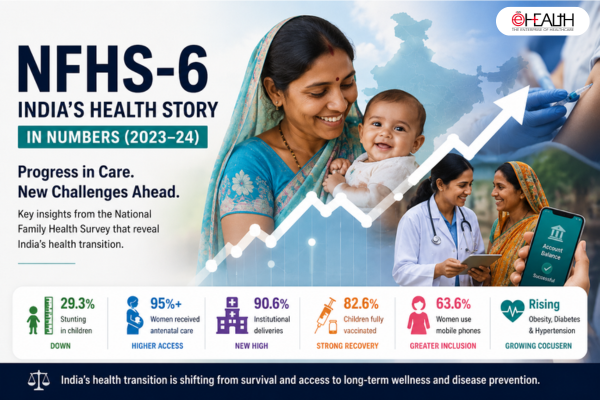
India's sixth National Family Health Survey (NFHS-6), covering 2023–24, confirms that stunting among children under five has fallen from 35.5% to 29.3% — a meaningful but insufficient gain against a backdrop of stagnant wasting rates and deeply inadequate dietary diversity across the country.
The survey's headline numbers tell a story of two Indias: one where health infrastructure has genuinely improved, and another where the food on the plate has not kept pace. Understanding that gap — and what it means for families, frontline workers, and the supplement market — is the purpose of this article.
NFHS-6 Key Nutrition Indicators at a Glance
| Indicator | NFHS-5 (2019–21) | NFHS-6 (2023–24) | Change |
|---|---|---|---|
| Stunting (children under 5) | 35.5% | 29.3% | ▼ 6.2 pp |
| Wasting (children under 5) | ~19% | ~19% (no significant change) | ≈ Flat |
| Children 6–23 months with adequate diet | ~11% | ~15% | ▲ 4 pp |
| Institutional births | ~89% | ~90% | ▲ 1 pp |
| Full vaccination (12–23 months) | ~77% | 87% | ▲ 10 pp |
| Breastfed within first hour of birth | ~41% | ~50% | ▲ 9 pp |
| Deliveries attended by skilled personnel | ~89% | 91% | ▲ 2 pp |
| Antenatal care (at least one visit) | ~97% | 95% | ≈ Stable |
Sources: NFHS-6 Fact Sheets, IIPS; The Hindu analysis by Swaminathan & Narayanan
The table makes the structural problem visible: health-system metrics have moved sharply upward, while diet-dependent metrics — wasting and adequate diet coverage — have barely shifted. That asymmetry is the central finding of NFHS-6 for anyone thinking about nutrition policy or supplementation strategy.
What Does NFHS-6 Actually Measure, and Why Does It Matter?
NFHS-6 is India's largest nationally representative household survey on population, health, and nutrition, conducted by the International Institute for Population Sciences (IIPS) under the Ministry of Health and Family Welfare. The sixth round covered 2023–24 and is the most recent benchmark available for tracking India's progress toward Sustainable Development Goal 2 (Zero Hunger) and SDG 3 (Good Health and Well-Being).
The survey measures anthropometric outcomes — height-for-age (stunting), weight-for-height (wasting), and weight-for-age (underweight) — alongside dietary diversity scores, feeding practices, and household-level food expenditure patterns. It does not directly measure serum micronutrient levels such as iron, vitamin D, zinc, or iodine, which means the deficiency picture it paints is inferential rather than biochemical. That caveat matters when translating survey findings into supplement recommendations.
Why Did Stunting Fall While Wasting Stayed Flat?
Swaminathan and Narayanan, writing in The Hindu, offer the clearest explanation available: gains in stunting reduction are attributable to better health-care access, improved immunisation, maternal education, and improvements in housing, water, and sanitation — not to improvements in diet quality or feeding practices.
Stunting reflects a chronic condition of prolonged sub-optimal food intake and repeated illness over months or years. It responds, albeit slowly, to systemic improvements in hygiene, infection control, and maternal health. Wasting, by contrast, is an acute condition reflecting whether a child has adequate weight for their current height — it is far more sensitive to immediate food intake and dietary quality. When wasting does not improve despite a decade of health-system investment, the message is unambiguous: food is the missing variable.
The 15% adequate-diet coverage figure for children aged 6–23 months is particularly alarming. It means that 85 out of every 100 young Indian children in the critical window of complementary feeding are not receiving what the ICMR-National Institute of Nutrition (NIN) food-based dietary guidelines would consider nutritionally adequate. This is the window — the first 1,000 days from conception to a child's second birthday — during which most brain growth occurs and during which nutritional insults have lifelong consequences.
What Are the Specific Micronutrient Gaps NFHS-6 Points Toward?
NFHS-6 does not publish serum micronutrient data, but the dietary patterns it documents — low pulse consumption, minimal fruit and vegetable intake, near-absent animal-source foods in many households, and rising processed-food expenditure — map predictably onto well-documented deficiency clusters in the Indian population.
Iron and folate. Anaemia remains endemic. NFHS-5 reported anaemia in roughly 67% of children aged 6–59 months and 57% of women aged 15–49. NFHS-6 data on anaemia was not fully disaggregated at the time of writing, but the dietary patterns documented — declining cereal consumption without compensatory increases in iron-rich foods — suggest no structural improvement. Iron-deficiency anaemia is the most prevalent micronutrient deficiency globally, and India accounts for a disproportionate share of its burden.
Vitamin D. India's paradox of widespread vitamin D deficiency despite abundant sunshine is well-established. The shift toward indoor work, increased use of sunscreen, darker skin pigmentation, and low dietary fat intake all suppress cutaneous synthesis. NFHS-6's documentation of rising processed-food expenditure at the expense of dairy and traditional fats does nothing to address this. Population surveys consistently find 70–90% prevalence of vitamin D deficiency (serum 25-hydroxyvitamin D level below 20 ng/mL) in urban Indian adults.
Zinc. Zinc deficiency arises from inadequate dietary intake or absorption sufficient to impair immune function, growth, and wound healing. India's predominantly cereal-and-pulse diet, high in phytates that inhibit zinc absorption, creates structural risk. Wasting — the indicator that has not improved — is directly linked to zinc status; zinc supplementation trials in Indian children have shown measurable reductions in diarrhoea incidence and modest improvements in linear growth.
Iodine. Universal salt iodisation has substantially reduced goitre prevalence, but iodine sufficiency is not the same as iodine adequacy for pregnant women and infants. NFHS-6's finding that only 50% of newborns are breastfed within the first hour of life — when colostrum, rich in iodine and immune factors, is most available — represents a missed opportunity at the most critical moment.
Vitamin B12. India's large vegetarian population faces structural B12 risk. This water-soluble vitamin is found almost exclusively in animal-source foods; its deficiency causes megaloblastic anaemia, irreversible neurological damage, and — in pregnant women — neural tube defects. The NFHS-6 dietary data showing minimal animal-source food consumption in large population segments makes B12 deficiency a silent but significant concern.
How Do Feeding Practices Translate Into Deficiency Risk?
The NFHS-6 complementary feeding data deserves granular examination. The Hindu's analysis of the survey notes that approximately 60% of children aged 6–8 months receive solid or semi-solid food — which sounds reasonable until you note that only 15% of children in the 6–23 month window receive an adequate diet. The gap between "receiving some solid food" and "receiving nutritionally adequate food" is enormous, and it is where most of India's micronutrient deficit is generated.
In India, complementary feeding is closely linked to the annaprasana ritual — the ceremonial first feeding of solid food, typically performed between six and twelve months. Any delay in this ritual translates directly into growth faltering. But the ritual's timing is only part of the problem; the quality of what is fed afterward matters far more. Traditional complementary foods — rice gruel, dal water, mashed banana — are calorically adequate but micronutrient-poor. Without deliberate diversification into eggs, dark leafy vegetables, legumes, and fortified foods, the child enters the second year of life already depleted.
Maternal time poverty compounds this. NFHS-6 reports that about 30% of women engaged in paid work in the past 12 months, but this figure substantially underestimates total work burden when unpaid agricultural and domestic labour is included. In rural areas without crèche facilities, infants are left with older siblings — often girls pulled from school — while mothers work in fields. The result is disrupted breastfeeding, delayed complementary feeding, and reduced dietary diversity at the most critical developmental window.
What Does the Processed Food Shift Mean for Adult Nutrition?
The NFHS-6 findings on household food expenditure deserve attention beyond the child nutrition frame. Recent Consumer Expenditure Survey data cited in the NFHS-6 analysis shows that Indian households are spending less on cereals and more on dairy, processed foods, and beverages. Swaminathan and Narayanan note that this "creates an impression of diversity which is not the same as nutritional adequacy."
This distinction is critical. Processed foods — packaged snacks, instant noodles, flavoured beverages, biscuits — are energy-dense but micronutrient-poor. They are also easily available, ready to eat, and packaged in affordable small packs that fit within daily household budgets. For a family that cannot afford pulses, millets, fruits, vegetables, animal foods, and nuts — the components of an ICMR-NIN adequate diet — a packet of biscuits and a flavoured drink may represent the most accessible calories available.
The nutritional consequence is hidden hunger: adequate or excess caloric intake alongside micronutrient depletion. This pattern is increasingly documented in middle-income urban India, where overweight and micronutrient deficiency coexist in the same individual — a phenomenon sometimes called the double burden of malnutrition. NFHS-6 does not fully quantify this double burden, but the dietary expenditure data points directly toward it.
For adults, the practical implication is that dietary diversification alone — without attention to food quality — will not close micronutrient gaps. A household that has shifted from rice and dal to packaged snacks and sweetened dairy drinks has diversified its food categories without improving its micronutrient intake. This is precisely the scenario where targeted supplementation becomes a rational complement to dietary counselling.
Which Population Groups Face the Highest Supplementation Need?
Based on the NFHS-6 data and the known biology of Indian dietary patterns, five groups face disproportionate micronutrient risk:
Pregnant and lactating women face elevated demands for iron, folate, iodine, vitamin D, calcium, and B12 simultaneously. NFHS-6 shows 95% antenatal care coverage, which means most women are theoretically reachable for supplementation — but the quality and compliance of iron-folic acid supplementation under the national programme remains inconsistent.
Children aged 6–23 months in the complementary feeding window are the highest-risk group for zinc, iron, vitamin A, and vitamin D deficiency. Only 15% receive an adequate diet; the remaining 85% are candidates for therapeutic or preventive micronutrient supplementation, ideally through fortified complementary foods rather than pharmaceutical supplements.
Adolescent girls — a group NFHS-6 tracks through anaemia and BMI data — enter pregnancy already depleted. Adolescent anaemia rates in India remain above 50% in most states. Weekly iron-folic acid supplementation through school programmes is policy, but coverage and compliance are uneven.
Vegetarian adults, particularly in states with high vegetarian prevalence (Gujarat, Rajasthan, Uttar Pradesh), face structural B12 and zinc risk that dietary change alone cannot easily address. For this group, B12 supplementation is not optional — it is a biological necessity given the near-complete absence of B12 in plant foods.
Urban professionals experiencing the processed-food transition face vitamin D, magnesium, and B-complex depletion alongside caloric adequacy or excess. This is the group most likely to self-purchase supplements, and the NFHS-6 dietary data provides a rational basis for their concern. For those exploring magnesium specifically, our guide to magnesium glycinate capsules in India covers form, dosing, and brand quality in detail.
What Does NFHS-6 Say About Regional Disparities?
The national averages in NFHS-6 obscure significant state-level variation. States in the northeastern region, Bihar, Uttar Pradesh, and Jharkhand consistently show higher stunting and wasting rates than southern and western states. Maharashtra and Kerala approach stunting rates closer to WHO thresholds for public health concern.
This regional heterogeneity matters for supplement strategy. A child in Kerala with a relatively diverse diet and high institutional birth coverage has a different micronutrient risk profile than a child in rural Bihar with limited dietary diversity and lower maternal education. National supplementation programmes — iron-folic acid, vitamin A supplementation, zinc for diarrhoea management — are calibrated to the national burden, but their implementation quality varies enormously by state.
The NFHS-6 data on vaccination coverage (87% nationally, with public facilities accounting for 97% of vaccinations) demonstrates that the frontline worker network — ASHAs, Anganwadi workers, ANMs — is capable of reaching nearly universal coverage when the intervention is well-resourced and monitored. The same network, if adequately trained and supplied, could achieve comparable coverage for micronutrient supplementation. The gap is not infrastructure; it is prioritisation and resourcing.
What Role Should Supplements Play Given the NFHS-6 Evidence?
Supplements are not a substitute for dietary improvement, and NFHS-6 makes clear that dietary improvement requires structural change — affordable healthy food, functional crèches, reduced maternal time poverty, culturally grounded behaviour change communication. No supplement can replicate the synergistic benefits of a diverse whole-food diet.
That said, the survey data makes a strong case for targeted supplementation in specific contexts:
Therapeutic use — severely wasted children, anaemic pregnant women, B12-deficient vegetarians — is unambiguous. These are clinical situations where supplementation is standard of care and the NFHS-6 data confirms the population burden is large.
Preventive use — iron-folic acid in adolescent girls, vitamin D in urban adults, zinc in children during diarrhoea episodes — is supported by both the dietary data in NFHS-6 and the existing evidence base for these interventions in Indian populations.
Lifestyle supplementation — the broader market of multivitamins, protein powders, and adaptogens consumed by urban middle-class adults — is harder to justify directly from NFHS-6 data, which focuses on under-five children and reproductive-age women. However, the processed-food transition documented in the survey does create a rational basis for filling specific gaps: vitamin D, B12, magnesium, and omega-3 fatty acids are the most evidence-supported choices for this demographic.
For those navigating blood sugar concerns alongside nutritional gaps — a combination increasingly common in the urban Indian population documented in NFHS-6's dietary expenditure data — our evidence-based protocol on berberine for insulin resistance provides a detailed framework grounded in Indian clinical data.
What Structural Changes Does NFHS-6 Demand?
The NFHS-6 data points to several systemic interventions that go beyond supplementation:
Crèche infrastructure. The absence of crèches in rural areas is a direct driver of disrupted breastfeeding and poor complementary feeding. Swaminathan and Narayanan describe crèches as "social infrastructure that enables women's economic participation and reduces unpaid care burdens" — not merely child development facilities. Scaling crèche models developed by NGOs, run by trained local women, would simultaneously improve child nutrition and women's economic agency.
District-level nutritionists and data analysts. Monthly anthropometric data is collected by Anganwadi workers but rarely analysed locally. The authors call for recruitment of a nutritionist and a data analyst at the district level to convert raw data into actionable feedback for frontline workers. This is a low-cost, high-use intervention that the NFHS-6 data strongly supports.
Fortification of complementary foods. Given that 85% of children aged 6–23 months do not receive an adequate diet, and given that dietary diversification faces structural affordability barriers, fortification of widely consumed complementary foods — rice, wheat flour, edible oil — with iron, zinc, vitamin A, and vitamin D offers the most scalable near-term solution. India's food fortification programme exists but coverage and compliance remain incomplete.
Male engagement in childcare. NFHS-6 implicitly documents the cost of unequal domestic labour distribution through its data on maternal time poverty. Behaviour change communication that engages men in childcare and shared domestic responsibilities — an approach the authors explicitly recommend — has evidence from multiple low- and middle-income country contexts showing improvements in child feeding practices and dietary diversity.
POSHAN Abhiyaan reorientation. The Prime Minister's Overarching Scheme for full Nourishment (POSHAN) Abhiyaan currently focuses on identification and rehabilitation of severely malnourished children. The NFHS-6 analysis argues that prevention of growth faltering must receive greater priority — early identification of stagnation in weight or length, with timely counselling, is more cost-effective than rehabilitation after severe malnutrition has set in.
How Should Individuals Respond to the NFHS-6 Evidence?
For individuals — parents, caregivers, health-conscious adults — the NFHS-6 data translates into several practical priorities:
For parents of children aged 0–2: The survey's finding that only 50% of newborns are breastfed within the first hour of life means that early breastfeeding initiation remains a high-impact, zero-cost intervention that is being missed at scale. Skin-to-skin contact immediately after birth and trained lactation support at institutional delivery facilities are the most evidence-supported tools.
For parents of children aged 6–23 months: The 15% adequate-diet figure means that most children in this window are not eating enough diversity. Practical diversification — adding egg yolk, mashed dal, dark leafy greens, and small amounts of animal-source foods to rice or roti-based complementary meals — is more effective than any supplement for this age group. Where dietary diversification is not feasible, micronutrient powders (MNPs) — sachets of iron, zinc, vitamin A, folate, and B12 that can be mixed into home-prepared food — are the WHO-recommended bridge.
For adolescent girls and women of reproductive age: Iron-folic acid supplementation is national policy but compliance is low. The NFHS-6 data on anaemia burden makes daily supplementation a rational personal health decision independent of programme delivery.
For vegetarian adults: B12 supplementation is not a lifestyle choice — it is a biological necessity for those who do not consume animal-source foods regularly. The NFHS-6 dietary data confirms that large population segments consume minimal animal-source foods, making B12 deficiency a population-level risk rather than an individual edge case.
For urban adults experiencing the processed-food transition: Vitamin D (1,000–2,000 IU daily), B12 (500 mcg daily for vegetarians), and magnesium glycinate (200–400 mg daily) represent the most evidence-supported supplementation choices for the dietary pattern NFHS-6 documents. These are not exotic interventions — they address the specific gaps created by the shift away from traditional whole-food diets toward processed, micronutrient-poor alternatives.
The Bottom Line: What NFHS-6 Tells Us About India's Nutrition Future
NFHS-6 is a progress report, not a crisis alert — and that framing matters. India has made genuine gains in health infrastructure, vaccination, maternal care, and sanitation. The stunting decline from 35.5% to 29.3% represents millions of children whose growth trajectories have improved. These gains should not be minimised.
But the survey's most important signal is structural: health-system improvements have hit their ceiling as drivers of nutrition improvement. The next percentage points of stunting reduction, and any meaningful reduction in wasting, will require improvements in diet quality, feeding practices, and food affordability that health-system investment alone cannot deliver.
The processed-food transition documented in household expenditure data is accelerating this challenge. As Indian households spend more on packaged, energy-dense, micronutrient-poor foods, the gap between caloric adequacy and nutritional adequacy will widen — not narrow. This is the hidden hunger trajectory, and NFHS-6 provides early warning that India is on it.
Targeted supplementation — iron-folic acid for pregnant women and adolescent girls, zinc for children with diarrhoea, vitamin D and B12 for vegetarian adults, micronutrient powders for children in the complementary feeding window — is a rational, evidence-supported response to the specific gaps the survey documents. It is not a substitute for structural food-system reform, but it is a bridge that can reduce harm while that reform is built.
The frontline worker network that achieved 87% vaccination coverage has the reach to deliver that bridge. What it needs is the resources, training, and political prioritisation that NFHS-6 now makes impossible to defer.
Last verified: 2026-06-19
Sources
- NFHS-6 reveals progress amid nutrition challenges - The Hindu
- National Family Health Survey (NFHS-6) 2023-2024 Fact Sheets - IIPS
- National Family Health Survey-6 findings — Complete coverage from The Hindu
- Best Magnesium Glycinate Capsules in India: Clean Label, Third-Party Tested Brands Worth Buying in 2026 - Nano Health Insights
- Berberine for Insulin Resistance and Blood Sugar Control: An Evidence-Based Protocol for Indians (2026) - Nano Health Insights