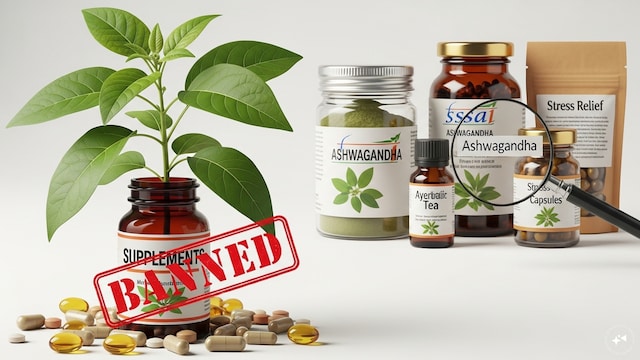
India's FSSAI banned ashwagandha leaf in 2026; root-only extracts are now the legal standard, but label accuracy remains a serious problem with up to 35-fold withanolide deviations reported.
Ashwagandha Root vs Leaf: Why the $1.5 Billion Market's Biggest Quality Crisis Matters for Indian Supplement Buyers in 2026
Ashwagandha (Withania somnifera) is an evergreen adaptogenic shrub used in Ayurvedic medicine for thousands of years. In 2026, it sits at the centre of a global regulatory storm: India's food safety authority has banned the leaf form entirely, Europe is conducting a formal review, and independent testing shows that withanolide content on supplement labels can deviate from actual content by anywhere from 2-fold to 35-fold. For Indian supplement buyers, the practical question is simple — what does this mean for the bottle sitting in your medicine cabinet?
The answer requires understanding three things at once: the genuine biochemical differences between root and leaf, the regulatory decisions now reshaping what is legally sold in India, and the analytical gaps that make quality verification harder than any label claim suggests.
Root vs Leaf vs Whole-Plant Extract: A Snapshot Comparison
The table below summarises the key differences across the forms of ashwagandha most commonly found in Indian supplements as of 2026.
| Feature | Root Extract | Leaf Extract | Root + Leaf (Whole-Plant) |
|---|---|---|---|
| Traditional Ayurvedic use | Extensively documented in classical texts | Minimal classical references; used in ethnomedicine | Not a classical category |
| Withaferin A concentration | Lower | Higher (key safety concern cited by FSSAI) | Variable; depends on ratio |
| Withanolide content accuracy | Frequently under-delivers vs label (up to 35× deviation) | No validated assay method exists | No validated assay method exists |
| Legal status in India (2026) | Permitted under FSSAI regulations | Banned in crude, extract, or any other form | Effectively banned (leaf component prohibited) |
| EU regulatory status | Under Article 8 review; not prohibited | Under Article 8 review; Denmark banned since 2023 | Under review |
| Clinical trial volume | ~150 trials, ~5,000 participants reviewed | Limited; mostly preclinical | Limited |
| Price differential | Baseline | Up to 100× cheaper than root | Intermediate |
| WHO recognition | Root recognised as the efficacy standard | Not recognised | Not recognised |
This table alone tells the story for Indian buyers: if you purchased a supplement containing leaf material before April 2026, that product is now non-compliant with Indian food law. If you are buying now, any compliant product on Indian shelves should carry root-only material — but compliance and quality are two different things.
What exactly is the difference between ashwagandha root and leaf?
Ashwagandha root is the underground storage organ of Withania somnifera, and it is the part that classical Ayurvedic texts — the Charaka Samhita, Ashtanga Hridayam, and others — consistently specify for therapeutic use. The root contains a complex mixture of withanolides (steroidal lactones), alkaloids, saponins, and iron, with the withanolides most associated with the adaptogenic, anti-stress, and sleep-supporting effects studied in clinical trials.
The leaf is a different matter. A 2026 review published in Pharmacognosy Research by researchers at the All India Institute of Ayurveda found that ashwagandha leaf contains numerous bioactive compounds also present in the root, and that preclinical and clinical studies have established diverse therapeutic benefits — particularly for anticancer, neurodegenerative, antimicrobial, and anti-inflammatory applications. The review concluded that leaf "can become a lead" for these purposes. That is a meaningful finding, but it is not the same as saying leaf is interchangeable with root for the stress, sleep, and testosterone applications that most Indian consumers are actually buying ashwagandha for.
The more immediate concern is withaferin A. India's Food Safety and Standards Authority of India (FSSAI) cited higher concentrations of withaferin A in leaf material as a primary reason for its April 2026 ban. Withaferin A is a withanolide with demonstrated cytotoxic properties — useful in cancer research, but a concern at the concentrations found in leaf when consumed as a daily supplement. The root contains withaferin A too, but at lower levels.
The leaf is also dramatically cheaper than root — up to 100 times cheaper, according to KSM-66, the world's best-selling ashwagandha root extract brand. That price gap creates a powerful economic incentive for substitution or adulteration.
What did India's regulators actually decide, and why does it matter?
In April 2026, two decisions landed within 24 hours of each other. India's Ministry of AYUSH mandated that only root-only material be used in AYUSH-regulated products. The very next day, FSSAI — India's food safety regulator, broadly analogous to the US FDA — issued an advisory banning ashwagandha leaf in crude, extract, or any other form from health supplements, nutraceuticals, food for special dietary use, and medical foods.
The FSSAI advisory was direct: it stated that certain manufacturers had been using ashwagandha leaves and their extracts in products despite this not being permitted under existing regulations. State food safety commissioners were instructed to enforce compliance immediately.
In May 2026, the Karnataka High Court in Bengaluru granted an interim stay of both the AYUSH directive and the FSSAI advisory, following petitions from eight parties. The outcome of the follow-up hearing remained unclear as of the date of this article. That legal uncertainty matters: it means the regulatory space in India is contested, and some manufacturers may be operating under the assumption that the stay permits continued use of leaf material.
For buyers, the practical implication is this: even if the stay is in force, the regulatory direction of travel is unambiguous. India's food safety establishment has concluded that leaf material does not belong in consumer supplements. Buying root-only products is the lower-risk choice regardless of the court's eventual ruling.
What is happening in Europe and other markets?
The European situation is more complex. The EU's Heads of Food Safety Agencies — an informal network of national food safety organisation heads — recommended initiating an Article 8 procedure under EU food supplement regulations. Article 8 is a listing mechanism, not a direct safety verdict, and its possible outcomes include prohibition, restriction, or classification as "under Community scrutiny." Ashwagandha is not recognised as a traditional herbal medicinal product in the EU, so there is no medicinal category to fall back on if the supplement category is restricted.
Country-level action has already begun. Denmark prohibited ashwagandha in food products in 2023. Poland limits daily intake to 3 grams of powdered root or 10 mg of withanolides. Hungary caps intake at 250 mg of dried root per day. Finland, the Netherlands, and Sweden are each considering limits or bans.
In July 2026, Kerry Group — which sells the Sensoril ashwagandha ingredient — formally launched its Safeguard Ashwagandha campaign, publishing its own safety data ahead of the EU review and hosting a European Parliament briefing. Botanist and natural products consultant Thomas Brendler, who chairs the US Pharmacopeia Botanical Dietary Supplements & Herbal Medicines Expert Committee, presented a safety review at that briefing covering close to 150 clinical trials in 5,000 participants. Brendler also guest-edited a nine-paper special issue on ashwagandha safety in Phytotherapy Research.
The European regulatory debate is running on three parallel tracks simultaneously: whether leaf has adequate evidence of safety and efficacy; whether classical Ayurvedic usage should determine what modern botanical products may contain; and whether regulators followed legally required processes in imposing restrictions. None of these questions has been definitively resolved.
Why is the quality problem so much worse than most buyers realise?
This is where the crisis goes deeper than a simple root-versus-leaf debate. The industry does not currently possess validated analytical methods capable of reliably distinguishing and assessing all the forms of ashwagandha on the market.
Thomas Brendler stated plainly that there is no published and validated method to assay anything but root preparations. If a product contains leaf material — disclosed or not — no standardised test can accurately characterise its withanolide profile. The absence of that method has two consequences: manufacturers cannot reliably verify their own products, and regulators cannot reliably verify manufacturer claims.
The label accuracy problem is severe even for root-only products. Blake Ebersole, president of NaturPro Scientific and co-founder of the Ashwagandha Standards Alliance, says that extracts advertised at 5% withanolides are "frequently tested to contain more than 10 times less than the stated value." The broader range of deviation documented across the market runs from 2-fold to 35-fold.
A 2021 review in Current Neuropharmacology found that many standardised commercial extracts contain "70%–95% of uncharacterised materials." A separate evidence-quality review by Rattray and Brendler concluded that safety "cannot be evaluated in a vacuum. It must be tethered to a verifiable chemical profile" — and noted that the authors had to reverse-engineer the composition of several commercial extracts because manufacturers generally do not disclose it.
Brendler has been careful to clarify what this means. His own methodology paper, published in the Phytotherapy Research special issue, found that USP and British Pharmacopoeia assay methods failed on non-root products. That finding was misreported in some media as evidence that half of all ashwagandha products were adulterated. His actual conclusion was different: "The problem is not that everything is adulterated. The problem is that the current analytical methods are not really fit for purpose."
That distinction matters enormously for buyers. A failed test does not necessarily mean a failed product — it may mean the test was not designed for the product being tested. But a test that cannot tell you what is in the bottle offers no protection at all.
What does the National Institutes of Health say about ashwagandha safety?
The US National Center for Complementary and Integrative Health (NCCIH) offers a measured summary worth quoting directly, because it reflects the state of the evidence without the commercial interests that colour much of the industry debate.
NCCIH notes that ashwagandha may be safe when taken in the short term — up to three months. There is not enough information to draw conclusions about long-term safety. Known adverse effects include drowsiness, stomach upset, diarrhoea, and vomiting. Rare cases of liver injury linked to ashwagandha supplements have been documented.
The NCCIH also flags specific populations who should avoid ashwagandha entirely: pregnant women, breastfeeding women, people scheduled for surgery, and those with autoimmune or thyroid disorders. Drug interactions are documented with diabetes medications, blood pressure medications, immunosuppressants, sedatives, anticonvulsants, thyroid hormone medications, and — because ashwagandha may increase testosterone — it should be avoided by people with hormone-sensitive prostate cancer.
The NCCIH's evidence summary on efficacy is similarly cautious. Research shows that some ashwagandha preparations may be effective for insomnia and stress. Evidence on anxiety is unclear. There is limited evidence for testosterone and sperm quality improvements over two to four months. Evidence is insufficient for asthma, athletic performance, cognitive function, diabetes, menopause, and female infertility.
This is a notably narrower set of supported uses than most supplement marketing claims suggest. It is also a reminder that "ashwagandha works" is not a complete sentence — the preparation, the dose, the duration, and the specific outcome all matter.
What are the human stakes beyond the regulatory debate?
The leaf-versus-root dispute is not purely a technical or regulatory argument. Approximately 25,000 acres in India are devoted to ashwagandha cultivation each year, supporting roughly 20,000 farming families and an estimated 250,000 to 300,000 people across the supply chain. A root-only restriction reduces the economic value of the crop, because the leaf — harvested alongside the root — can no longer be sold into the supplement market.
Shaheen Majeed, global CEO and managing director of Sabinsa and a founding member of the Ashwagandha Standards Alliance, has been explicit about this: "A root-only restriction reduces the economic value of that crop, limits rural employment and directly affects household income. Those impacts deserve far more scientific and economic consideration than they appear to have received."
That is a legitimate concern, and it is worth holding alongside the safety argument. The regulatory decision to ban leaf was made quickly — the FSSAI advisory and the AYUSH directive arrived within 24 hours of each other — and the Karnataka High Court's interim stay suggests that at least some affected parties believe the process was legally flawed, independent of the underlying science.
The India domestic ashwagandha market, while growing rapidly at a projected CAGR of 17.78% through 2032, was valued at just $3.58 million USD in 2024 — a fraction of the global $1.5 billion market. The global market's trajectory is what gives the regulatory dispute its weight: if the EU follows India's lead and restricts leaf material, the consequences for ingredient suppliers, farmers, and finished-product brands will be substantial.
How should Indian supplement buyers navigate this in practice?
The honest answer is that navigating this market requires more effort than reading a label. Here is what the available evidence supports.
Choose root-only products. This is now the legally compliant choice in India, and it is backed by the largest body of clinical evidence. Root-only products from established brands — KSM-66, Sensoril, and similar — have the most documented safety and efficacy data. KSM-66 is a full-spectrum, organic ashwagandha root extract standardised to a minimum of 5% withanolides using a water-based extraction process, and it explicitly commits to never using leaf material.
Be sceptical of withanolide percentage claims. Given that extracts claiming 5% withanolides have been found to contain more than 10 times less, a higher percentage on the label does not reliably mean a better product. Third-party testing certification — from organisations like NSF International, USP, or Informed Sport — provides more meaningful assurance than label claims alone.
Check for third-party certificates of analysis. Reputable brands will provide or link to batch-specific certificates of analysis from accredited laboratories. If a brand cannot or will not provide this, that is a meaningful signal.
Match the product to the evidence base. The strongest clinical evidence for ashwagandha root covers stress reduction, sleep quality, and modest testosterone support in men over two to four months. If you are buying ashwagandha for athletic performance, cognitive function, or immune support, the evidence base is thinner and the benefit-risk calculation changes accordingly.
Consult a healthcare provider if you are in a high-risk group. The NCCIH's contraindications are not theoretical. Thyroid interactions, liver injury cases, and pregnancy risks are all documented. If you take any of the medications listed above, or have an autoimmune or thyroid condition, this conversation should happen before you open the bottle.
Understand that "Ayurvedic" on the label does not guarantee root-only content. The FSSAI advisory was issued precisely because manufacturers were using leaf material in products falling under Ayurvedic and nutraceutical categories. The label category and the actual content are not the same thing — not until the analytical methods and enforcement catch up.
What needs to happen for the market to fix itself?
The Ashwagandha Standards Alliance — co-founded by Blake Ebersole and supported by Sabinsa, among others — is working on validated analytical methods that can reliably distinguish root from leaf and accurately quantify the full withanolide profile in mixed-material extracts. Until those methods exist and are adopted by regulators globally, the quality vacuum will persist.
Abhijeet Morde, vice president of early discovery and translation science at OmniActive (which sells the root-only ingredient Zenroot), framed the underlying principle clearly: "The ashwagandha leaf-versus-root fight isn't really about ashwagandha — it's about whether the science on the label actually matches what's in the bottle."
That framing applies to the entire botanical supplement category, not just ashwagandha. The crisis in this $1.5 billion market is, as Sabinsa's Majeed put it, a question about "the future of science-based botanical regulation." The outcome of the Karnataka High Court hearing, the EU's Article 8 process, and the Ashwagandha Standards Alliance's analytical work will collectively determine whether that future is built on verifiable chemistry or on marketing claims that no current test can reliably confirm.
For Indian buyers in 2026, the safest path is the narrowest one: root-only, third-party tested, from a brand that publishes its certificates of analysis. Everything else is a bet on a label.
For related reading on evidence-based Ayurvedic supplementation, see our guides on Arjuna for heart health and Berberine for insulin resistance and blood sugar.
Sources
- Ashwagandha regulation fight threatens industry — New Hope Network
- Ashwagandha: Usefulness and Safety — NCCIH (NIH)
- Can Ashwagandha Leaf be Replaced with its Root in Therapeutics? — Pharmacognosy Research
- FSSAI directs manufacturers to use only Ashwagandha roots, bans leaves in food products — Telegraph India
- KSM-66: Tackling 'leaf adulteration' in the ashwagandha market — Vitafoods Insights
- India Ashwagandha Market Size, Trends and Forecast to 2032 — Data Bridge Market Research
- Regulatory review: India's ashwagandha leaf ban — NutraIngredients
- KSM-66 Ashwagandha — Official Brand Page