A 130,000-person observational study linked long-term melatonin use (12+ months) to ~90% higher heart failure risk, but cannot prove causation and has significant limitations.
Does Long-Term Melatonin Use Raise Heart Failure Risk? What a Large New Study Shows
Adults with chronic insomnia who used melatonin for 12 months or more had approximately a 90% higher hazard of developing heart failure over five years compared with matched non-users, according to a large preliminary study presented at the American Heart Association's Scientific Sessions 2025. That headline number is striking — but the study is observational, has not yet been peer-reviewed as a full manuscript, and cannot establish that melatonin itself caused the harm. Here is what the data actually shows, what experts say is missing, and what it means if you currently take melatonin to sleep.
Key Numbers at a Glance
| Outcome | Melatonin Group (n = 65,414) | Control Group (n = 65,414) | Hazard Ratio (95% CI) |
|---|---|---|---|
| Incident heart failure (primary) | 4.6% (3,021 people) | 2.7% (1,797 people) | 1.89 (1.78–2.00) |
| Heart failure hospitalization | 19.0% (12,411 people) | 6.6% (4,309 people) | 3.44 (3.32–3.56) |
| All-cause mortality | 7.8% (5,118 people) | 4.3% (2,820 people) | 2.09 (1.99–2.18) |
| HF risk in sensitivity analysis (≥2 fills, ≥90 days apart) | — | — | 1.82 |
Source: Circulation, Vol. 152, Suppl. 3, Abstract 4371606
All post-match standardized mean differences between the two groups were below 0.02, meaning the propensity-score matching was tight. The absolute risk difference for incident heart failure was 1.9 percentage points — modest in absolute terms, but statistically significant (p < 0.001) across a very large sample.
What Is Melatonin and Why Do So Many People Take It?
Melatonin is a hormone produced naturally by the pineal gland that regulates the body's circadian rhythm — the internal clock governing sleep and wakefulness. Levels rise in darkness and fall during daylight. Synthetic melatonin is chemically identical to the body's own hormone and is sold over the counter in countries including the United States and India, while requiring a prescription in the United Kingdom and Japan.
Because it is "natural" in origin, melatonin carries a widespread perception of being harmless. In the U.S. alone, it has become one of the most commonly used dietary supplements. In India, melatonin is classified as a prescription drug under Schedule H, though enforcement at retail level is inconsistent and many people obtain it without a prescription for jet lag, shift-work sleep disorder, or general insomnia.
The supplement is not regulated with the same rigour as pharmaceutical drugs in most markets. In the U.S., over-the-counter supplements do not require government approval for quality and consistency, meaning actual melatonin content can vary significantly from what is printed on the label — a complication that also affects interpretation of the new study.
What Did the Study Actually Do?
Researchers led by Dr. Ekenedilichukwu Nnadi of SUNY Downstate/Kings County Primary Care in Brooklyn queried the TriNetX Global Research Network, a large international database of de-identified electronic health records, for adults aged 18 and older with a diagnosis of insomnia (ICD-10 code F51.0).
Long-term melatonin use was defined as having at least one melatonin prescription recorded in electronic health records and at least 365 days of documented exposure. People in the control group had no melatonin recorded anywhere in their medical history.
Key exclusions: anyone already diagnosed with heart failure, and anyone prescribed other sleep medications such as benzodiazepines. This was important to isolate the melatonin signal from other hypnotic drugs.
The two groups — 65,414 melatonin users and 65,414 controls — were matched 1:1 using propensity-score matching across more than 40 variables: demographics, 15 comorbidities, concomitant cardiometabolic drugs, laboratory values, vital signs, and healthcare utilisation. Outcomes were then tracked over the five years following the index date using stratified Cox proportional hazard models.
The primary endpoint was a new diagnosis of heart failure (ICD-10 I50). Secondary endpoints were hospitalisation for heart failure and all-cause mortality.
What Did the Results Show?
The primary analysis found that incident heart failure occurred in 4.6% of melatonin users versus 2.7% of controls, yielding a hazard ratio of 1.89 — roughly a 90% higher relative risk.
The secondary outcomes were even more dramatic. Heart failure-related hospitalisation occurred in 19.0% of the melatonin group compared with 6.6% of controls (HR 3.44). All-cause mortality was 7.8% versus 4.3% (HR 2.09). The hospitalisation gap is particularly large, though the researchers note this may partly reflect how hospitals code related diagnoses — not every hospitalisation code necessarily represents a new heart failure diagnosis.
A sensitivity analysis restricted to participants who had filled at least two melatonin prescriptions at least 90 days apart — a stricter definition of sustained use — returned a hazard ratio of 1.82 for incident heart failure, consistent with the primary finding. That consistency across different analytical approaches is one of the study's stronger features.
"Melatonin supplements are widely thought of as a safe and 'natural' option to support better sleep, so it was striking to see such consistent and significant increases in serious health outcomes, even after balancing for many other risk factors," said lead author Dr. Nnadi.
What Are the Study's Most Important Limitations?
The limitations here are not minor footnotes — they are central to how much weight this finding should carry in clinical practice.
Observational design, no causation. The study identifies an association, not a cause. People who use melatonin long-term may differ from non-users in ways the matching could not fully capture, including unmeasured confounders like severity of insomnia, depression, anxiety, or other psychiatric conditions. As Dr. Nnadi acknowledged, "worse insomnia, depression/anxiety, or the use of other sleep-enhancing medicines might be linked to both melatonin use and heart risk."
Reverse causation is plausible. Cleveland Clinic cardiologist Dr. Michael Hill points out that some participants may have already been in the early, undiagnosed stages of heart failure when the study began — and early heart failure itself disrupts sleep, which could drive melatonin use. If so, the association would reflect pre-existing disease rather than drug effect.
OTC use is invisible in the data. Because melatonin is available over the counter in the U.S. and many other countries, people who bought it without a prescription would appear in the "non-melatonin" control group even if they were actually taking it. This misclassification would tend to underestimate any true effect — or create a spurious one, depending on the direction of the bias.
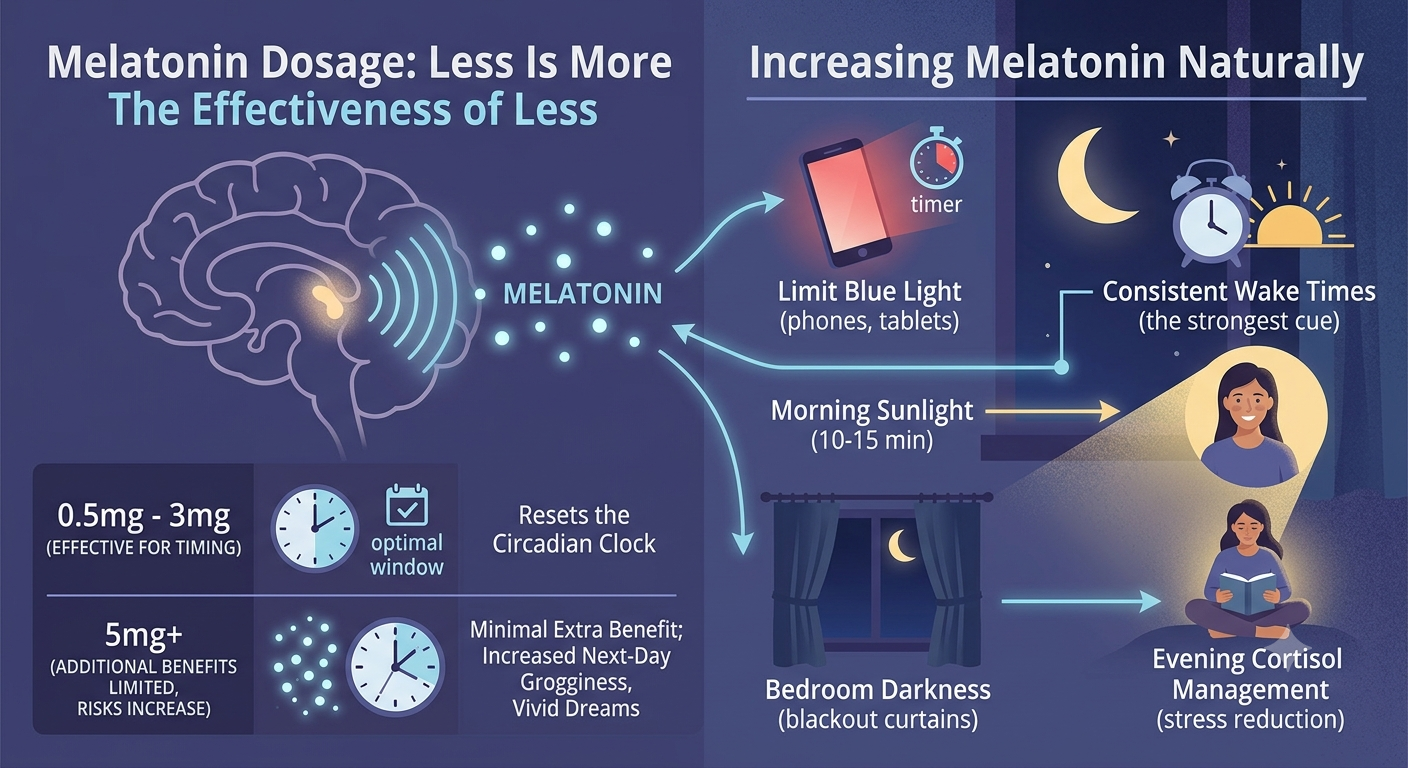
No dosage information. The study did not capture how much melatonin participants took. Doses in commercial supplements range from 0.5 mg to 10 mg or more, and the dose-response relationship for any cardiovascular effect is entirely unknown.
No peer review yet. As University of Rochester Medicine cardiologist Dr. Andrew Mathias notes, this was a research abstract presented at a conference. It has not yet been published as a full manuscript in a peer-reviewed journal, which means the methodology has not been subjected to independent expert scrutiny.
International heterogeneity. TriNetX draws from multiple countries with different melatonin regulations. In the UK, melatonin requires a prescription; in the U.S., it does not. The researchers did not have access to participants' locations because the data was de-identified, making it difficult to know whether the "melatonin group" and "control group" are truly comparable across different healthcare systems.
Sleep apnea not accounted for. Northwestern Medicine cardiologist Dr. Micah Eimer highlights that sleep apnea — a condition strongly associated with both heart failure and sleep disturbance — was not controlled for. People with undiagnosed sleep apnea might be more likely to seek out melatonin and also independently face higher cardiovascular risk.
What Do Independent Experts Say?
Marie-Pierre St-Onge, PhD, chair of the writing group for the American Heart Association's 2025 scientific statement on sleep and cardiometabolic health, was not involved in the research but weighed in on the findings. She expressed surprise that physicians would prescribe melatonin for insomnia for more than 365 days, noting that melatonin is not indicated for the treatment of insomnia in the U.S. — it is approved for circadian rhythm disorders and short-term sleep adjustment, not chronic insomnia management. "People should be aware that it should not be taken chronically without a proper indication," she said.
Dr. Hill at Cleveland Clinic adds an important counterpoint: some randomised clinical trials have actually found possible benefits of melatonin in heart failure patients, including improvements in symptoms, quality of life, and a blood marker (NT-proBNP) reflecting heart failure burden, in a six-month randomised trial. That does not negate the new observational data, but it illustrates that the cardiovascular biology of melatonin is not straightforwardly harmful — the picture is genuinely uncertain.
The American College of Cardiology's coverage of the study concluded that the findings "emphasize the need to clarify the cardiovascular safety profile of melatonin use as benign chronic therapy" — framing this as a call for further research rather than an immediate clinical alarm.
Does This Mean You Should Stop Taking Melatonin?
Not necessarily — but the study does raise legitimate questions worth discussing with a doctor, particularly for anyone who has been taking melatonin nightly for a year or more.
For short-term, occasional use — jet lag, shift-work adjustment, a temporary bout of poor sleep — the existing evidence does not suggest meaningful cardiovascular risk. The American Academy of Sleep Medicine recommends melatonin primarily for circadian rhythm disorders, not as a first-line treatment for chronic insomnia.
Northwestern Medicine's Dr. Eimer identifies specific groups who may warrant extra caution: people already diagnosed with heart failure, adults over 65 (who are more likely to be on multiple medications), and individuals with existing cardiovascular risk factors such as hypertension, diabetes, or high cholesterol. Melatonin may interact with beta-blockers and anticoagulants, adding another layer of complexity for people on those drugs.
University of Rochester Medicine experts emphasise that the overall rate of heart failure in the study remained low in absolute terms — 4.6% over five years in the melatonin group — and that the findings require further study before they can change clinical guidance. The difference in risk was real in statistical terms, but the absolute numbers mean the vast majority of melatonin users in the study did not develop heart failure.
What Should Happen Next in the Research?
The authors themselves call for randomised controlled trials to determine whether long-term melatonin use affects cardiovascular health and, if so, through what mechanism. An RCT would eliminate the confounding that plagues observational data: participants would be randomly assigned to melatonin or placebo, removing the possibility that sicker or more anxious people self-select into melatonin use.
Mechanistic research is also needed. Scientists are still exploring how melatonin interacts with receptors in the cardiovascular system — it is thought to influence blood pressure and heart rhythm, but these pathways are not well characterised. Dose-response data would help establish whether the risk, if real, is tied to the high doses (5–10 mg) common in commercial supplements or whether it appears at lower physiological doses (0.5–1 mg) as well.
Until those trials exist, the honest answer is that we do not know whether melatonin causes heart failure. What we know is that in a very large, carefully matched observational dataset, long-term documented melatonin use was associated with substantially worse cardiovascular outcomes — and that association persisted across multiple analytical approaches. That is enough to warrant serious scientific attention, even if it is not enough to warrant panic.
Practical Takeaways for People Currently Using Melatonin
If you take melatonin occasionally for jet lag or a short-term sleep disruption, the current evidence does not suggest you need to stop. If you have been taking it nightly for 12 months or more to manage chronic insomnia, this study is a reasonable prompt to have a conversation with your doctor — not because causation is established, but because chronic insomnia itself has cardiovascular consequences and there may be better-evidenced treatments available.
Cognitive behavioural therapy for insomnia (CBT-I) is the first-line treatment for chronic insomnia according to most sleep medicine guidelines, with a strong evidence base and none of the cardiovascular uncertainty now attached to long-term melatonin. Other lifestyle approaches — consistent sleep and wake times, limiting light exposure at night, regular physical activity — address the circadian biology that melatonin is meant to support, without the unknowns of chronic supplementation.
If you are in a higher-risk group — older adult, existing heart condition, multiple cardiovascular risk factors — the conversation with your doctor is more urgent. Share a complete list of all supplements and medications so potential interactions can be assessed.
The melatonin and heart failure story is not closed. This is a well-powered signal from real-world data that demands rigorous follow-up. The researchers, the American Heart Association, and independent cardiologists all agree on that much — and they also agree that this single observational abstract, however large and carefully matched, is not sufficient evidence to conclude that melatonin causes heart failure. The science needs to catch up with the supplement's popularity, and this study is a meaningful push in that direction.
If you are interested in evidence-based approaches to cardiovascular health through supplementation, our guides on Arjuna for heart health and berberine for blood sugar and metabolic health examine the clinical literature in similar depth.
Sources
- Long-term melatonin use linked to 90% higher heart failure risk | ScienceDaily
- Long-term use of melatonin supplements to support sleep may have negative health effects | American Heart Association Newsroom
- Abstract 4371606: Effect of Long-term Melatonin Supplementation on Incidence of Heart Failure in Patients with Insomnia | Circulation (AHA Journals)
- Can Melatonin Cause Heart Failure? | University of Rochester Medicine
- How Melatonin Impacts Heart Health | Cleveland Clinic Health Essentials
- Research Suggests Long-Term Melatonin Use For Insomnia Increases HF Risk | American College of Cardiology
- Does Taking Melatonin Raise Your Risk of Heart Failure? | Northwestern Medicine