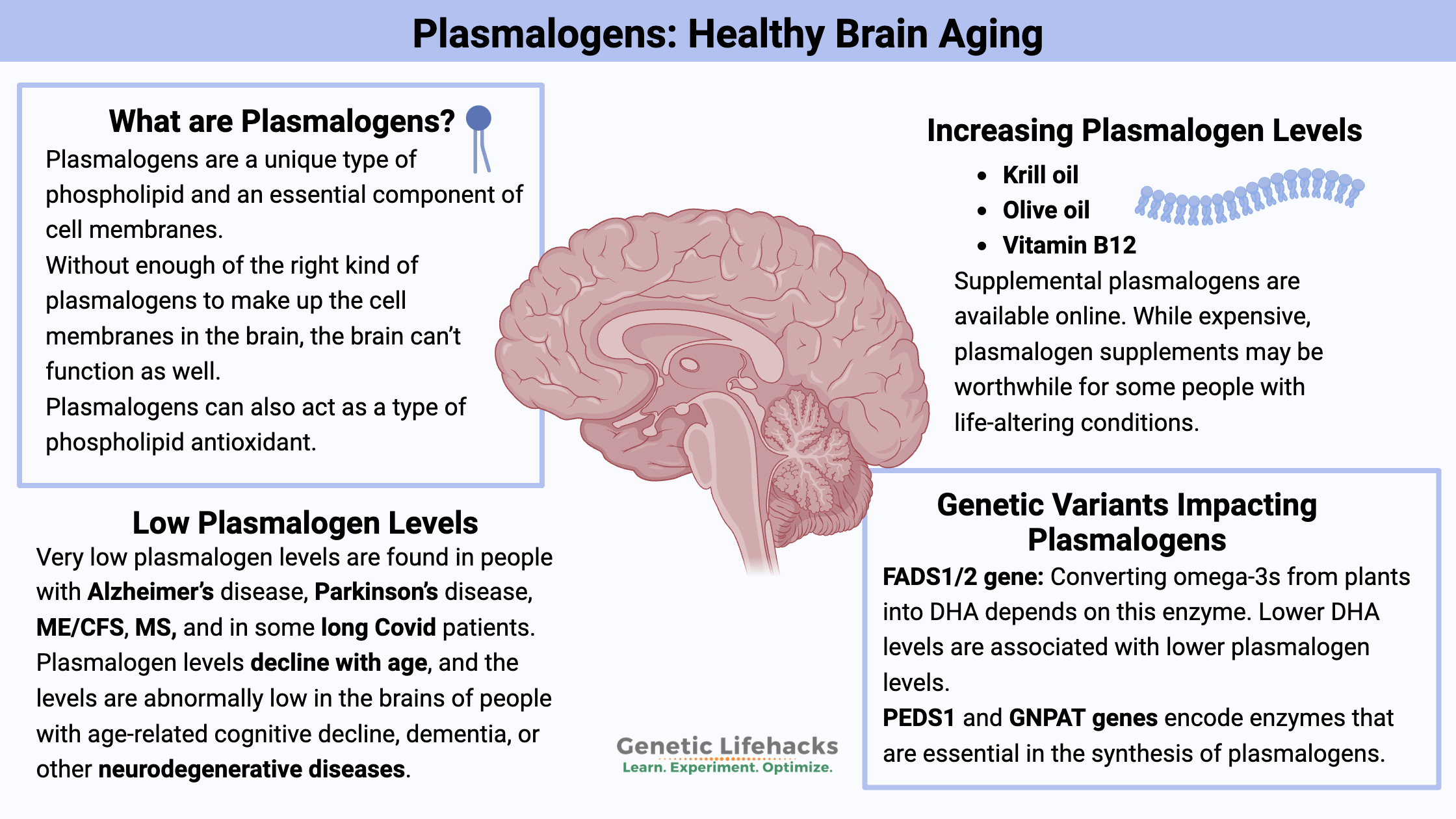
Plasmalogens are brain-critical phospholipids that decline sharply with age; sea squirt-derived supplements reversed memory loss and synaptic decline in aged mice, but solid human trials are still lacking.
What Are Plasmalogens and Do They Actually Reverse Brain Aging? What the New Sea Squirt Research Shows
Plasmalogens are a specialized subclass of phospholipid — fat molecules with a distinctive vinyl-ether chemical bond — that form a critical structural component of cell membranes throughout the body, with the highest concentrations found in the brain, heart, and immune cells. Their levels decline by an estimated 40% between the ages of 40 and 70, and that decline has been consistently observed in people with Alzheimer's disease and Parkinson's disease. A September 2026 report from Xi'an Jiaotong-Liverpool University, Stanford University, Shanghai Jiao Tong University, and the University of Chinese Academy of Sciences, summarizing research published in Frontiers in Molecular Biosciences, found that dietary plasmalogen supplements derived from sea squirts reversed multiple measurable signs of aging in older mice, including memory loss, synaptic deterioration, and brain inflammation.
The findings are striking enough that the study's corresponding author, Professor Lei Fu, says he personally takes a plasmalogen supplement every day. They are also preliminary enough that no clinician should interpret them as a prescription for eating sea squirts. Here is what the science actually shows, where the gaps are, and what a consumer thinking about plasmalogen supplements needs to understand right now.
Key Facts at a Glance
| Feature | Detail | Source |
|---|---|---|
| What plasmalogens are | Phospholipid subclass with vinyl-ether bond; ~10–20% of all body phospholipids | PMC / Molecules 2023 |
| Brain concentration | ~20% of brain cell membranes; especially rich in the myelin sheath | Dr. Frank Lipman |
| Age-related decline | ~40% drop between ages 40 and 70 | Dr. Frank Lipman |
| Disease association | Reduced levels observed in Alzheimer's, Parkinson's, MS, ME/CFS | Genetic Lifehacks |
| Mouse study outcome | Improved Morris water maze performance, more/better synapses, less neuroinflammation, darker hair regrowth | ScienceDaily / Xi'an Jiaotong-Liverpool University |
| Supplement dose used in mice | ~300–500× the concentration found in a typical serving of chicken or scallops | The Conversation |
| Human clinical evidence | One Japanese RCT (n > 300): cognitive improvement in women under 77 with mild cognitive impairment taking 1 mg/day for 24 weeks | Dr. Frank Lipman |
| Primary marine food sources | Sea squirts (meongge in Korea, hoya in Japan), scallops, mussels | EurekAlert |
| Biosynthesis location in the body | Peroxisomes and endoplasmic reticulum | Genetic Lifehacks |
What Exactly Are Plasmalogens?
Plasmalogens are ether-linked phospholipids distinguished from ordinary phospholipids by the presence of a vinyl-ether bond at the sn-1 position of the glycerol backbone, rather than the ester bond found in conventional fats. That structural difference matters biologically: the vinyl-ether bond is chemically reactive, which allows plasmalogens to act as sacrificial antioxidants, scavenging reactive oxygen species (ROS) before they can oxidize the delicate fatty acids in neuronal membranes.
At the sn-2 position, plasmalogens typically carry polyunsaturated fatty acids such as DHA (docosahexaenoic acid), contributing to membrane fluidity. This combination — a reactive ether bond plus a flexible polyunsaturated tail — gives plasmalogens a dual role: they make cell membranes more fluid and flexible while simultaneously acting as a built-in antioxidant shield.
Two main subtypes exist. Ethanolamine plasmalogens (also called plasmenylethanolamines) are the dominant form in the brain and are most strongly implicated in neurodegenerative diseases. Choline plasmalogens are concentrated in the heart and are thought to offer cardiovascular protection. Together, plasmalogens account for roughly 10–20% of all phospholipids in the human body.
The body synthesizes most of its plasmalogens in the liver, using peroxisomes as the primary manufacturing site. Plasmalogens also enter the body through food — animal meats, seafood, and especially marine invertebrates — but most dietary plasmalogens are broken down during digestion before they can be absorbed intact. This is one reason supplement researchers have focused on concentrated, orally bioavailable forms derived from sea squirts and scallops.
Why Do Plasmalogen Levels Matter for the Aging Brain?
The brain is, in a sense, plasmalogen-central. Approximately 20% of brain cell membranes are composed of plasmalogens, with especially high concentrations in the myelin sheath — the insulating layer that wraps around nerve cell axons and allows electrical signals to travel quickly and efficiently. Without adequate plasmalogen levels, several things go wrong simultaneously.
Membrane fluidity drops. Neurons depend on fluid, flexible membranes to release neurotransmitter-containing vesicles at synapses. Animal studies show that low plasmalogen levels cause reduced neurotransmitter release due to decreased vesicle transport. Oxidative stress rises in parallel: as plasmalogens scavenge ROS, they are consumed and degraded, creating a feedback loop that can rapidly strip the brain of its plasmalogen reserves. Inflammatory signaling also becomes dysregulated — plasmalogen-depleted membranes appear to permit more unchecked neuroinflammation.
Plasmalogen levels drop by an estimated 40% between ages 40 and 70. That trajectory overlaps uncomfortably with the timeline on which most people begin to notice subtle cognitive changes — slower recall, less mental agility, reduced working memory. Whether the plasmalogen decline causes those changes, or whether both are downstream effects of a common aging process, remains an open question. The correlation is consistent enough, though, that researchers have begun treating plasmalogen restoration as a plausible therapeutic target.
The disease associations sharpen the concern further. Reduced plasmalogen levels have been observed in Alzheimer's disease, Parkinson's disease, multiple sclerosis, and ME/CFS. In Alzheimer's specifically, past research has shown that plasmalogen levels in the blood decrease with age and especially in people with Alzheimer's disease. Whether low plasmalogens are a cause, a consequence, or a biomarker of these diseases is still being worked out.
What Did the Sea Squirt Study Actually Find?
The study, published in Frontiers in Molecular Biosciences, involved researchers from Xi'an Jiaotong-Liverpool University, Stanford University, Shanghai Jiao Tong University, and the University of Chinese Academy of Sciences. They added plasmalogen supplements — derived from sea squirts (Ascidiacea) — to the diets of aged mice and then measured both behavioral and biological outcomes.
Memory and learning. The primary behavioral test was the Morris water maze, a standard laboratory tool for assessing spatial learning and memory. Mice are placed in a pool with a submerged platform; because mice dislike swimming, they are motivated to find and remember the platform's location. Younger mice typically locate it quickly after a few days of training. Older mice take significantly longer. After five days of training, aged mice receiving plasmalogens performed much more like younger animals, reaching the platform significantly faster than aged control mice.
Synaptic changes. Examining the mice's brains, the researchers found that plasmalogen-fed animals had a higher number of synapses, and those synapses appeared to be in better structural condition than those in untreated aged mice. Synapses are the junctions through which nerve cells communicate, and their number and quality are directly linked to learning capacity and memory. Synaptic plasticity tends to diminish with age, and the findings suggest that increasing dietary plasmalogens may help protect synapses from some forms of age-related deterioration.
Neuroinflammation. Chronic, low-grade inflammation in the brain is increasingly recognized as a driver of neurodegeneration. Plasmalogen-treated mice showed substantially lower brain inflammation than controls — a reduction that likely contributed to their better cognitive performance, since excessive immune activation in the brain can damage neurons and disrupt synaptic function.
Hair regrowth. Perhaps the most visually striking finding: aged mice fed plasmalogens grew new black hair that was thicker and glossier than aged mice not fed the supplement. This suggests the compound's effects extend beyond the brain to other tissues associated with aging, though the mechanism for this particular finding is not yet understood.
Neurotrophic factors. Professor Fu noted that plasmalogens significantly increased the number of molecules that aid the growth and development of neurons and synapses in the brain — a class of proteins known as neurotrophic factors. This points toward neuroregeneration, not just neuroprotection, as a possible mechanism.
How Might Plasmalogens Actually Work in the Brain?
Scientists do not yet have a definitive mechanistic explanation. Professor Fu outlined three plausible pathways, and it is likely that all three operate simultaneously rather than in isolation.
Direct membrane effects. Plasmalogens may increase the fluidity and flexibility of synaptic membranes, affecting the transmission of impulses between neurons. A more fluid synaptic membrane facilitates faster vesicle fusion and neurotransmitter release — the physical basis of neural communication. This is the most mechanistically straightforward explanation and is supported by in-vitro evidence showing that plasmalogen-depleted membranes are stiffer and less functional.
Neuroregeneration via neurotrophic signaling. The increase in neurotrophic factors observed in treated mice suggests that plasmalogens may actively stimulate the growth and repair of neural circuits, not merely preserve existing ones. Neuroregeneration — the repair, renewal, or regrowth of nerve cells and their connections — declines with age but may be partially recoverable. If plasmalogens upregulate neurotrophic factor production, they could help the aging brain rebuild some of the circuitry lost to normal senescence.
Gut-brain axis modulation. Some studies have shown that dietary plasmalogens affect the microorganisms in the gut, and the connection between gut organisms and the brain influences neurodegeneration. The gut microbiome communicates with the brain through immune signals, the vagus nerve, and metabolic byproducts. If plasmalogen supplementation shifts the gut microbiome toward a more neuroprotective profile, that could explain some of the cognitive improvements observed in mice — and would have significant implications for how supplements are formulated and dosed.
Antioxidant protection. The vinyl-ether bond in plasmalogens is a reactive target for ROS, neutralizing oxidative damage before it reaches more critical cellular machinery. Plasmalogens can scavenge reactive oxygen species, protecting cells from oxidative stress. In the high-oxidative-stress environment of the aging brain, this function alone could meaningfully slow the rate of neuronal damage.
What Is the Human Evidence So Far?
This is where appropriate caution is essential. The mouse data is compelling, but improvements observed in mice do not necessarily mean that eating sea squirts or taking plasmalogen supplements will reverse aging in humans.
The most substantive human trial to date is a Japanese randomized controlled study involving over 300 participants with mild cognitive impairment. Participants took a 1 mg daily plasmalogen supplement (derived from scallops) for 24 weeks. Meaningful and measurable cognitive improvements were found — but only in women and in people under the age of 77. Why this subgroup responded while others did not is not understood, and the study has not been replicated at scale.
There is also a methodological caveat worth flagging about the mouse study itself. The plasmalogen doses given to mice were approximately 300 to 500 times higher than the concentration found in a typical serving of chicken or scallops. Translating that dose to a human equivalent is not straightforward, and it raises questions about what a realistic supplementation protocol would look like and whether it would be safe over the long term.
The Morris water maze test used to assess memory also carries a known limitation: it relies partly on sensory abilities, particularly vision. Older mice tend to suffer a loss of sensory skills such as blindness and hearing with age, so the perceived improvement in memory could partly reflect improved sensory function rather than memory per se. This does not invalidate the findings, but it does mean the results warrant some nuance in interpretation.
Where Do Sea Squirts Fit In — and What Other Foods Contain Plasmalogens?
Sea squirts (class Ascidiacea) are marine invertebrates eaten in parts of Asia. In Korea, they are known as meongge (멍게) and are commonly eaten raw or in dishes like bibimbap. In Japan, they are called hoya (ホヤ) and are considered a delicacy. Sea squirts contain high levels of plasmalogens, which is why they became the focus of this research.
Other dietary sources include chicken, pork, beef, lamb, mussels, and scallops. The practical limitation is that most ingested plasmalogen gets broken down in the digestive process, so getting enough through diet alone is usually not possible. The supplement industry has responded by developing concentrated plasmalogen products, mostly derived from sea squirts and scallops, formulated to survive digestion and reach systemic circulation.
Some researchers argue that as humans shifted from hunter-gatherer diets rich in animal organs and seafood toward agricultural diets heavy in grains, plasmalogen intake dropped substantially — alongside omega-3 intake — contributing to higher rates of neuroinflammation and cognitive decline in modern populations. This is a plausible hypothesis but remains speculative.
For those interested in increasing plasmalogen intake through food rather than supplements, seafood — particularly bivalves like scallops and mussels — offers the most concentrated dietary source available in most markets. Sea squirts are available in Korean and Japanese grocery stores and restaurants and represent the richest single food source identified in the research literature.
Readers already exploring related marine-derived nutrients may find that algae-based omega-3 DHA supplements offer a complementary approach to supporting brain membrane health, since DHA is one of the polyunsaturated fatty acids carried by plasmalogens at the sn-2 position.
Are Plasmalogen Supplements Safe to Take?
The safety profile of plasmalogen supplements appears favorable in the existing literature, though long-term human data is limited. Side effects appear to be virtually non-existent based on current evidence, and the compounds are endogenous — meaning the body already produces and uses them, which reduces the likelihood of toxicity at moderate supplemental doses.
The Japanese RCT used a dose of 1 mg per day for 24 weeks without reported adverse effects. The mouse study, by contrast, used doses 300–500 times higher than typical dietary exposure, and whether those concentrations would be safe in humans over months or years has not been tested.
Anyone considering plasmalogen supplementation should be aware that the supplement market is largely unregulated and product quality varies considerably. Look for supplements that specify the plasmalogen subtype (ethanolamine plasmalogens for brain support), disclose the marine source, and provide third-party testing documentation. Given that the human evidence base is still thin, this is a supplement category best explored in consultation with a physician or integrative health practitioner — particularly for individuals with existing neurological conditions or those taking medications that affect lipid metabolism.
The Broader Context: Geroprotectors and the Future of Anti-Aging Research
Plasmalogens sit within a larger and rapidly expanding field of research into what scientists call geroprotectors — compounds that delay cellular aging and reduce the risk of developing multiple age-related diseases simultaneously. Over 200 geroprotectors have been tested in animals, with many showing improvements in organ function and delays in the onset of conditions like osteoarthritis, heart disease, and Alzheimer's in laboratory models.
Translating any geroprotector from animal models to human clinical use faces a structural problem. Drug approval pathways are designed around specific diseases diagnosed in specific patients — not around the prevention of aging across multiple organ systems simultaneously. Testing a compound that might prevent Alzheimer's, heart disease, and sarcopenia all at once requires trial designs that do not yet exist at scale, and the timelines and costs are enormous.
Marine plasmalogens have attracted particular attention because they are naturally occurring, food-derived, and available as supplements without a prescription. That lowers the barrier to human experimentation considerably, even if it also means the evidence base develops more slowly than it would for a pharmaceutical compound under active clinical development.
The sea squirt study is described by its authors as the first to show, in detail, how plasmalogens affect the aging brain — meaning the mechanistic picture is genuinely new, not just a replication of prior findings. That novelty is scientifically significant. It also means the field is at an early stage, and the findings should be weighted accordingly: promising, directionally consistent with prior work, but not yet sufficient to support strong clinical recommendations.
What Should You Actually Do With This Information?
The honest answer: watch the space, and consider dietary sources before supplements.
The mechanistic logic for plasmalogens is sound. They are endogenous, they decline with age, their decline correlates with cognitive deterioration and neurodegenerative disease, and restoring them in animal models produces measurable improvements across multiple aging-related parameters. That is a more coherent scientific story than many supplement categories can claim.
But the human evidence is thin. One RCT showing benefit in a specific subgroup of women under 77 is not a foundation for broad recommendations. The mouse doses were pharmacological, not nutritional. Long-term safety of concentrated supplementation in humans has not been established.
What is reasonable: eating more plasmalogen-rich seafood — scallops, mussels, and for those with access to them, sea squirts — as part of a diet already oriented toward brain health. Pairing that with omega-3 DHA from algae or fish sources addresses the related question of DHA availability in brain membranes. Managing oxidative stress through diet, exercise, and sleep protects the plasmalogens already present in your brain from being consumed faster than they can be replaced.
For those at elevated risk of Alzheimer's — based on family history, APOE4 status, or early cognitive symptoms — a conversation with a physician about plasmalogen supplementation is reasonable given the current evidence, with the understanding that this is an emerging area and not a proven therapy.
The sea squirt findings are genuinely interesting science. They are not a cure for brain aging. They are a well-designed signal pointing toward a biological pathway worth investigating further — and that is exactly how they should be understood.
Sources
- Stanford scientists discover a seafood that can reverse signs of aging | ScienceDaily
- Eating sea squirts may reverse the signs of ageing, study shows | EurekAlert
- Marine Plasmalogens: A Gift from the Sea with Benefits for Age-Associated Diseases | PMC / Molecules 2023
- Eating sea squirts reverses signs of ageing in mice – new research | The Conversation
- Plasmalogens: Healthy Brain Aging and More | Genetic Lifehacks
- Better Brain Function for Life? Parsing the Promise of Plasmalogens | Dr. Frank Lipman
- Plasmalogens Eliminate Aging-Associated Synaptic Defects and Microglia-Mediated Neuroinflammation in Mice | Frontiers in Molecular Biosciences
- Xi'an Jiaotong-Liverpool University — Eating sea squirts may reverse the signs of ageing