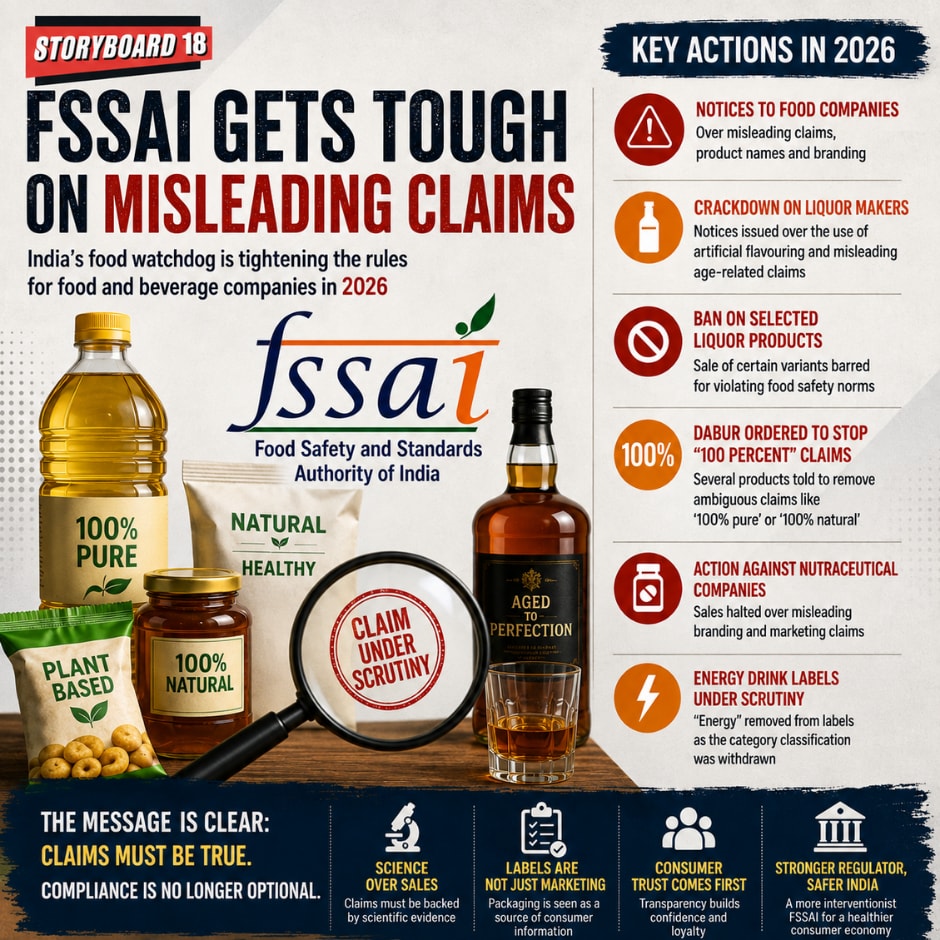
FSSAI issued 150+ notices in 2026 to major food brands for false health and labelling claims; Bournvita's withdrawal of nutrient-comparison claims marks a broader regulatory reset for Indian consumers.
Why Is FSSAI Tightening Rules on Food and Supplement Claims in India? What 150+ Notices Mean for Buyers in 2026
India's food regulator has issued more than 150 notices to food and supplement companies in 2026 — the largest single enforcement wave in recent memory — targeting misleading advertisements, unsubstantiated health claims, and labelling violations across some of the country's most recognisable packaged-food brands.
The Food Safety and Standards Authority of India (FSSAI) is the statutory body established under the Food Safety and Standards Act, 2006, responsible for setting science-based standards for food articles and regulating their manufacture, storage, distribution, sale, and import across India. Its current enforcement push goes well beyond routine compliance checks: it signals a structural shift in how the regulator expects companies to prove what they print on a label.
The table below summarises the key companies named in the crackdown, the nature of claims under scrutiny, and the documented response so far.
| Company | Claim Category Under Scrutiny | Documented Response (2026) |
|---|---|---|
| Mondelez India (Bournvita) | Health claims, nutrient-comparison claims, children's nutrition marketing | Withdrew health and nutrient-comparison claims |
| Nestlé India | Health and nutritional claims on packaged products | Received FSSAI notice; response under review |
| PepsiCo India | Beverage health/purity claims | Received FSSAI notice |
| Coca-Cola India | Beverage health/purity claims | Received FSSAI notice |
| Abbott India | Supplement and nutritional health claims | Received FSSAI notice |
| Red Bull India | Energy drink health/performance claims | Received FSSAI notice |
| Danone India | Nutritional and health claims | Received FSSAI notice |
| Ferrero India | Nutritional claims on confectionery | Received FSSAI notice |
| Kenvue | Consumer health product claims | Received FSSAI notice |
Sources: The Hindu, Times of India
What triggered the 150+ notices in 2026?
The immediate catalyst was a pattern of claims that regulators found could not be substantiated under the Food Safety and Standards (Advertising and Claims) Regulations, 2018 — the primary rulebook governing what food and supplement companies can say about their products in India.
The Bournvita case is the most visible example. Mondelez India's malted drink has occupied a particularly sensitive space in Indian households because its marketing has historically been tied to children's nutrition — a segment where the regulator applies heightened scrutiny. When FSSAI examined Bournvita's health and nutrient-comparison claims, it found them non-compliant, and Mondelez chose to withdraw those claims rather than contest the notices. That withdrawal, reported by The Hindu, became the public face of a much wider enforcement action.
The notices are not limited to children's products. The "100% pure" claim — used across edible oils, juices, honey, and dairy — is under direct challenge. FSSAI's position is that a claim of absolute purity requires analytical proof, and that companies using such language without documented substantiation are in breach of labelling regulations. Times of India reported that several companies have already begun withdrawing these claims following the notices, even before formal adjudication.
The regulatory pressure also connects to a broader institutional agenda. On March 2, 2026, FSSAI's 49th Central Advisory Committee meeting urged states and Union Territories to strengthen food safety enforcement through risk-based inspections and targeted surveillance of high-risk food categories including milk products, edible oils, spices, and honey — precisely the categories where purity claims are most commercially loaded. The meeting also emphasised stricter action against non-compliant food businesses and improving transparency in enforcement outcomes, as covered in the JSA Law newsletter on March–June 2026 regulatory developments.
What rules govern food and supplement claims in India?
A food claim is defined under Indian law as any representation that states, suggests, or implies that a food has particular qualities relating to its origin, nutritional properties, nature, processing, composition, or any other quality. This definition matters because it is broad enough to cover not just explicit health claims but implied ones too — a product image showing a muscular athlete can constitute a performance claim even without a single word of text.
The governing framework has three main pillars.
The Food Safety and Standards (Advertising and Claims) Regulations, 2018 set out which categories of claims are permitted (nutrient content claims, comparative claims, health claims, reduction-of-disease-risk claims), what evidence is required to substantiate each category, and which claims are outright prohibited. Prohibited claims include those that are false, misleading, or deceptive; those that cast doubt on the safety of similar foods; and those that exploit consumer fear or lack of knowledge.
The Food Safety and Standards (Labelling and Display) Regulations, 2020 govern what must appear on a label, in what font size, and in what position. FSSAI notified amendments to these regulations in 2026, refining requirements for nutritional disclosures, non-retail packaging, exemptions for minimally processed raw agricultural products, and mandatory information on bulk food containers. These amendments come into force from July 1, 2027, per the JSA Law regulatory newsletter.
Front-of-pack labelling (FOPL) remains the most contested frontier. India's proposed warning-label framework — intended to flag products high in sugar, salt, or saturated fat with a prominent on-pack warning — has been under discussion for years. The JSA Law newsletter notes that scrutiny over delays in finalising this framework increased noticeably during the March–June 2026 period, suggesting the current enforcement wave on claims may partly be a way of applying pressure while the FOPL rules remain unresolved.
For supplement buyers specifically, the implications are significant. Products marketed as "immunity boosters," "energy enhancers," or "brain health" supplements fall squarely within the claims framework. If a company cannot produce the clinical or compositional evidence required to substantiate such a claim, the claim must be removed — regardless of how long it has appeared on the label or how familiar it has become to consumers.
Which types of claims are most commonly challenged?
Based on the 2026 enforcement actions, three categories of claims are drawing the most scrutiny.
Nutrient-comparison claims — statements that a product contains more of a beneficial nutrient, or less of a harmful one, than a competitor or a reference food — require a defined reference food, a minimum percentage difference, and analytical data. Bournvita's withdrawal falls into this category.
Absolute purity claims — "100% pure," "100% natural," "100% real fruit" — are treated by FSSAI as nutrient content claims requiring substantiation. The challenge is that "100%" is a mathematical absolute: any detectable contaminant, additive, or processing residue can render the claim technically false. Several companies have found it easier to remove the claim than to defend it analytically.
Health and disease-risk-reduction claims — statements linking a food or ingredient to a health outcome — are the most heavily regulated category globally. India's 2018 regulations require pre-approval or compliance with a positive list of permitted claims. Energy drink and supplement brands have been particularly exposed here, since performance and recovery claims are commercially central to their marketing but scientifically difficult to substantiate at the product level.
Why does the Bournvita case matter beyond one brand?
Bournvita is not simply a product; it is a category signal. For decades, malted health drinks in India have been sold on the implicit promise that they make children stronger, smarter, or more competitive. The marketing vocabulary — "taller, stronger, sharper" — has been so normalised that many parents treat these products as nutritional supplements rather than flavoured sugar-and-malt beverages.
FSSAI's action against Bournvita's specific claims forces a reckoning with that vocabulary across the entire malted drinks category. If Mondelez cannot substantiate a nutrient-comparison claim for one of India's most established health drink brands, the evidentiary bar for similar claims by smaller or newer entrants is implicitly raised.
This matters for supplement buyers because the same marketing logic — "clinically proven," "doctor recommended," "scientifically formulated" — is used extensively in the protein powder, multivitamin, omega-3, and herbal supplement segments. Our guide to best health supplements in India (2026) notes that claim verification is one of the most important filters a buyer can apply, and the FSSAI crackdown provides a regulatory basis for demanding that verification.
What are the regulatory reforms running alongside the enforcement push?
The 150+ notices are the enforcement side of a broader reform agenda. On the compliance side, FSSAI and the Ministry of Health and Family Welfare have approved several structural changes that will reshape how food businesses operate in India.
Perpetual FSSAI licences: Registrations and licences will no longer require periodic renewal. This reduces compliance friction for small and medium food businesses, but it also means FSSAI must rely more heavily on risk-based inspections rather than renewal-triggered reviews to catch non-compliant operators. The revised turnover thresholds for registration categories came into effect from April 1, 2026, per the JSA Law newsletter.
Street vendor integration: Street food vendors registered under the Street Vendors (Protection of Livelihood and Regulation of Street Vending) Act, 2014, are now deemed registered under FSSAI, eliminating duplicate registration requirements. This is primarily a small-business relief measure, but it also brings a large segment of the informal food economy formally within FSSAI's regulatory ambit.
Technology-enabled risk-based inspections: FSSAI is introducing a system that prioritises inspections based on product risk, compliance history, audit performance, and enforcement inputs. For large packaged-food companies, a history of labelling violations or claim disputes will directly increase inspection frequency — a compliance incentive that periodic renewal never provided.
Import regulation amendments: FSSAI published amendments to food import regulations in late 2025, effective May 1, 2026, allowing notified laboratories to adopt validated international methods of analysis (AOAC, ISO, Codex Alimentarius, and others) when no specific test method is prescribed in the manual. The USDA GAIN report on these amendments notes that laboratories must also provide signed analysis reports within five days of receiving a sample — a tighter turnaround than previously required.
What does this mean for supplement buyers in India right now?
The practical implications for a consumer buying protein powders, multivitamins, herbal extracts, or functional foods in 2026 are concrete and actionable.
Treat "100% pure" as an unverified claim until further notice. FSSAI's enforcement action makes clear that this phrase has been used loosely across categories. Until a brand can point to third-party analytical data supporting it, the claim carries no more informational value than a marketing slogan.
Look for claims that reference specific quantities, not vague benefits. A label that says "contains 500 mg of Vitamin C per serving" is a nutrient content claim that can be verified analytically. A label that says "boosts immunity" is a health claim requiring substantiation under the 2018 regulations — and is precisely the type of claim currently under FSSAI scrutiny.
Check whether the brand has received an FSSAI notice. The regulator has not published a full public list of all 150+ notice recipients, but media reporting has named the major companies. If a brand you use appears on that list, it does not mean the product is unsafe — it means the labelling or advertising claims are under review. Watch for voluntary claim withdrawals or label changes as a signal of compliance.
Prefer products with third-party certifications. Certifications from bodies like NSF International, Informed Sport, or FSSAI's own quality mark indicate that the product has been tested against a defined standard. These are not foolproof, but they represent a higher evidentiary bar than self-declared claims.
Be especially cautious with children's nutrition products. FSSAI applies heightened scrutiny to products marketed for children, and the Bournvita case illustrates that even long-established brands can be found non-compliant. When choosing a supplement or fortified food for a child, the nutrient content declared on the label — not the marketing imagery or comparison claims — is the relevant data point.
For buyers navigating specific supplement categories, our evidence-based guides cover algae omega-3 DHA for vegetarians, berberine for blood sugar management, and curcumin supplements for joint health — all of which apply the same claim-verification lens that FSSAI is now enforcing at the regulatory level.
How does India's approach compare to global standards?
India's 2018 Advertising and Claims Regulations broadly align with the Codex Alimentarius framework for nutrition and health claims, which most major food-exporting nations reference. The European Union's Regulation (EC) No 1924/2006 on nutrition and health claims is often cited as the gold standard: it maintains a pre-approved list of permitted health claims, each linked to a specific scientific opinion from the European Food Safety Authority (EFSA). India does not yet have an equivalent pre-approved list of the same depth, which is one reason the current enforcement action relies on notices and voluntary withdrawals rather than automatic disqualification.
The United States takes a different approach. The FDA distinguishes between "structure/function claims" (which do not require pre-approval but must be truthful and not misleading) and "health claims" (which require FDA authorisation based on significant scientific agreement). India's framework sits closer to the EU model in intent — requiring substantiation — but closer to the US model in practice, given the absence of a full pre-approved list.
The gap between intent and practice is precisely what FSSAI is trying to close in 2026. The 150+ notices are, in effect, a signal that the regulator is moving from a framework that existed on paper to one that will be enforced in practice.
What should food and supplement companies do to comply?
A food or supplement company operating in India in 2026 faces a clear compliance checklist, even if FSSAI has not published one explicitly.
Audit every claim on every label, advertisement, and online product listing. The notices cover misleading advertisements and online product listings, not just physical labels. A claim removed from a label but still present in an e-commerce product description remains a compliance risk.
Maintain a substantiation file for each claim. A substantiation file is the documented body of evidence — clinical studies, compositional analyses, systematic reviews — that supports a specific claim made about a specific product. FSSAI can request this file during an inspection or in response to a complaint.
Apply particular caution to comparative and absolute claims. "Better than," "more than," "100%," and similar superlatives require the most rigorous substantiation and are the most likely to attract regulatory attention.
Monitor the FOPL rulemaking. If India finalises a front-of-pack warning label system — which the JSA Law newsletter suggests remains a live policy priority — products high in sugar, salt, or saturated fat will face mandatory on-pack warnings regardless of any positive health claims they make. Companies that have built their marketing around health imagery for products with poor nutritional profiles face the greatest exposure.
What is the timeline for further regulatory changes?
Several regulatory milestones are already on the calendar.
- July 1, 2027: FSSAI's amended Labelling and Display Regulations come into force, with refined requirements for nutritional disclosures and mandatory information on bulk food containers.
- Ongoing: Front-of-pack labelling framework finalisation — no confirmed date as of August 2026, but regulatory pressure is building.
- Ongoing: Risk-based inspection system rollout, prioritising high-risk categories including milk products, edible oils, spices, and honey.
For supplement buyers, the July 2027 labelling amendments are the most immediately relevant. They will require more detailed nutritional disclosures, which should make it easier to compare products on actual nutrient content rather than marketing claims.
The broader trajectory is clear: FSSAI is moving toward a regime where a claim is only as good as the evidence behind it, and where the burden of proof sits firmly with the manufacturer. For consumers, that is an unambiguous improvement. For companies that have built market share on aspirational but unsubstantiated language, the adjustment will be costly.
The bottom line for Indian consumers in 2026
The FSSAI's 150+ notices represent the most significant enforcement action against food and supplement labelling in India's recent regulatory history. The Bournvita withdrawal is the most visible outcome, but it is one data point in a pattern that spans energy drinks, nutritional supplements, packaged juices, edible oils, and children's health foods.
A food or supplement claim is compliant under Indian law only when it is truthful, not misleading, capable of being substantiated by evidence, and consistent with the permitted categories in the 2018 Advertising and Claims Regulations. The current enforcement wave is FSSAI's way of testing whether the industry's claims actually meet that definition — and the early results suggest many do not.
For buyers, the practical upshot is straightforward: the label is a starting point, not a conclusion. Cross-reference nutrient content claims against the declared nutritional information panel, look for third-party testing certifications, and treat any absolute or comparative claim with the same scepticism that FSSAI is now applying at the regulatory level. The regulator is doing more of the work than it used to — but informed consumers remain the most effective check on misleading claims.
Sources
- From Bournvita to '100% Pure': Why is FSSAI tightening the rules on food claims? | Explained — The Hindu
- FSSAI crackdown: Food companies withdraw '100%' and health claims after notices — Times of India
- JSA Newsletter | Food and Consumer Protection | March to June 2026 Edition — JSA Law
- India: FSSAI Publishes Amendments in Import Regulations — USDA GAIN Report
- FSSAI Official Website
- Best Health Supplements to Take in India (2026) — EV Index India
- Best Algae Omega-3 DHA Supplements for Vegetarians — EV Index India
- Berberine for Insulin Resistance and Blood Sugar in India: An Evidence-Based Protocol (2026) — EV Index India
- Best Curcumin Supplements for Joint Health in India: A Buyer's Comparison — EV Index India